

In today’s fast changing environment, a lot of exciting and positive changes can be seen in our lifestyles. However, a majority of us have also got one thing in common – STRESS. We can sense it, but tend to ignore it. We can also see that stress related health issues are commonly being reported. Many are manageable, but there are also lots of cases where it has been fatal. While on one hand, life expectancy has gone up, it is also a fact that a lot of unexpected deaths are being reported at a young age – be it students or young working professionals committing suicide or young people in their 30s or 40s getting heart attacks.
What is very clear is that at an early age people need to bring in a work-life balance, to avoid such consequences.
Yoga for a Stress free Life
A typical Yoga routine for a beginner
1. Sukshma Vyayam Yoga ( subtle yoga) techniques : Start with these. This can be for 10 mins. Sukshma Yoga takes no time or preparation. These little exercises open up subtle energy channels and in a session as short as 7 minutes, you can feel a highly palpable difference. A few examples are :
- Pinch your eyebrows 5-6 times using your thumb and the index figure
- Squeeze your eyes tight and then open them wide. Repeat this for 10-15 times.
- Shake your hands for 2 minutes, rotate your neck, etc.
2. Practice Pranayama : Pranayama comes from two Sanskrit words: prana, meaning “life force energy,” and yama, meaning “control” – and refers to breath-control exercises.
- Dirga Pranayama: The three part breathe – a simple breathing exercise. It brings your awareness to the present moment and calms your mind. This technique requires no special sound or position to achieve a relaxed and focused state of awareness.
- Anulom Vilom Pranayama: which is also called as Alternate Nostril Breathing. Anulom in Sanskrit means “natural order” and Viloma means “ going against”
- Bhramari Pranayama: which is also called humming bee breathe. Bhramari is a Sanskrit word meaning black Indian bee.
3. Practising Asanas : Now that your body is warmed up, practice some basic asanas which helps you in releasing stress and anxiety. Always keep in mind these general guidelines when practicing yoga. This can be performed for 10 mins.
- Move slowly in and out of the poses.
- Keep your breath smooth and even throughout the practice.
- Practice with an empty stomach.
- Never strain or force yourself beyond your current abilities.
- Keep the exact order of this sequence, as it has been organised to bring you the most benefits.
- Balasana : The Child pose – This is a resting posture that calms your mind and eases stress. It benefits the nervous and lymphatic system
- Marjariasana: The Cat pose – Soothes and stretches the lower back. Relieve stress and massages the spine.
- Apanasana : The Knees to Chest pose — stretches your back and releases spinal tension. Because your body is compact in the pose, your thoughts are more easily drawn inward, which calms the mind.
- Supta Baddha Konasana: The Reclined Bound Angle/Cobbler’s pose — stretches the hips, groins, and inner thigh muscles. It also opens the chest and improves oxygen flow while deeply relaxing the whole body.
- Viparita Karani : The Legs Up the Wall pose- This helps in stress reduction. Helps renew blood and lymph drainage back into the heart area
- Savasana: The Corpse pose – This puts body at ease and emphasise total relaxation. This triggers a state of deep rest that slows breathing, lowers blood pressure and also quieten the nervous system.
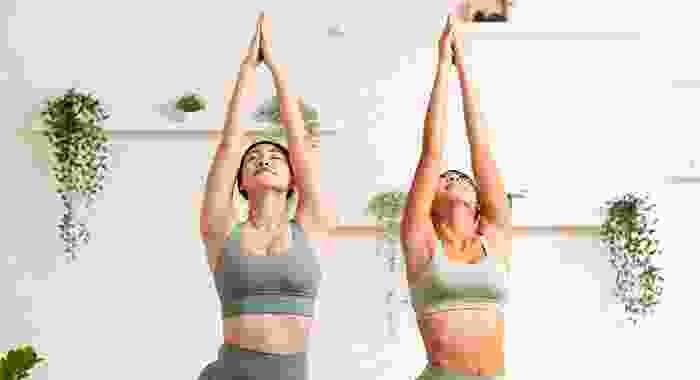
4. Practising Meditation : Meditation is an approach to training the mind, similar to the way that fitness is an approach to training the body. This can be performed for 10 mins.
- Concentration Meditation : Concentration meditation involves focusing on a single point. This could entail following the breath, repeating a single word or mantra, staring at a candle flame, listening to a repetitive gong, or counting beads on a mala. Since focusing the mind is challenging, a beginner might meditate for only a few minutes and then work up to longer durations. In this form of meditation, you simply refocus your awareness on the chosen object of attention each time you notice your mind wandering. Rather than pursuing random thoughts, you simply let them go. Through this process, your ability to concentrate improves.
- Mindfulness Meditation : Mindfulness meditation encourages the practitioner to observe wandering thoughts as they drift through the mind. The intention is not to get involved with the thoughts or to judge them, but simply to be aware of each mental note as it arises. You can see how your thoughts and feelings tend to move in particular patterns. Over time, you can become more aware of the human tendency to quickly judge an experience as good or bad, pleasant or unpleasant. With practice, an inner balance develops.
Once you start practising regularly , you can gradually increase the duration and the type of exercise as well.
Fads last for a short while; genuinely beneficial habits continue for ever. Yoga is a life changer. Once it is adopted there is no going away from it.